Category: Uncategorized

  • Neighbors and goodbyes

    Neighbors and goodbyes

    Where would we be without neighbors?

    It’s been a tumultuous week. The movers—three men and a yellow Penske truck—arrived last Saturday. They were quick, efficient, and courteous, which was delightful. Two of the men had worked together for 37 years; the third was a much younger man who looked as if he could bench-press the whole truck. He didn’t—but carried out stacks of book boxes with apparent ease. I don’t think he was thrilled about that task, though; at one point, he turned to me and said, “You sure have a lot of books.” I agreed. And then he said, “You do know that there are PDFs?”
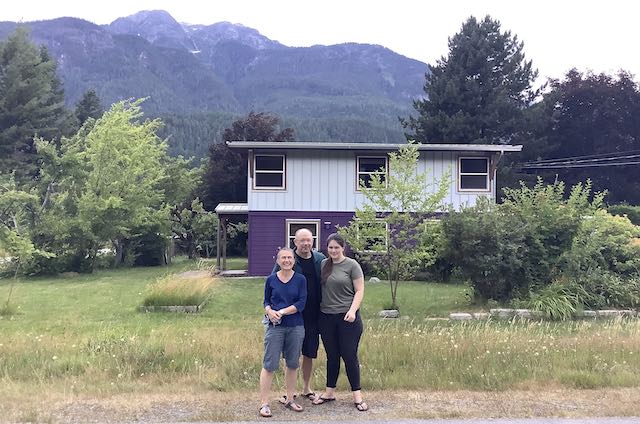
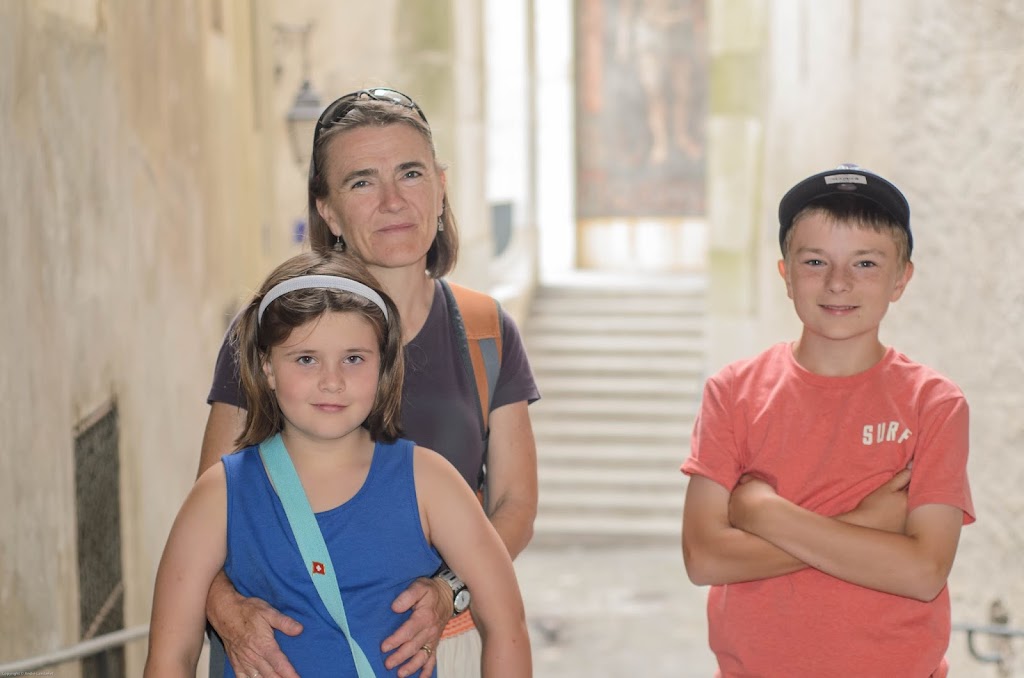
    Photo of Sophia, Nathalie, and André; Pierre was visiting friends!

    Within a few hours, the enormous stacks of book boxes, the furniture, the big boxes marked “fragile,” all were securely strapped in place, and off went the truck. That propelled us into moving sale mode: hauling what we weren’t taking out onto the driveway, trying to figure out what this table or that bike or that eleven-year-old tv is worth. In the end, we did what we often do: we improvised. So, on Sunday morning, when people asked what this lamp or that bookcase or the other lawn seeder cost, there were lots of shrugged shoulders and whispered conversations and finally a price, delivered not as a final statement but as a sort of plea: “Twenty-five dollars…?”

    We didn’t sell a lot of stuff, of course, but we had lots of help, especially from our friend and neighbor Camille, who was indefatigable. She had ideas for everything; singlehandedly solved most of our problems; and made us smile. Thanks, Camille, and Inky, and Dougal; you’ve been the best neighbors we could have hoped for.

    For the rest of the week, we kept working on the rest of the things we needed to do: print out all the papers we need for a cross-border move; figure out what we have to do with banks, the post office, and all the other sources of paper confusion; make runs to the landfill to get rid of the things that could not be repurposed, sold, or recycled; and all that.

    We’ll miss Brackendale. We’ll miss the view of the mountains; we’ll miss the river; most of all, we’ll miss our friends and neighbors here. We’ve become a part of a community: on our street, with neighbors like Camille, Inky, and Dougal; Shane and Sandy; our next-door neighbor Glenda, whose garden is magnificent despite the relentless efforts of a semi-feral pet rabbit owned but not controlled by another family in the neighborhood; Barry and Camilla down on Rod; our new neighbors, Lauren, Derek, and Hannah. We’ll miss the little post office on Government Road and its quixotic postmistress.

    I’ll miss seeing the friends I’ve made at work; the friends I met while watching our kids play soccer and baseball; or through the kids’ schools. I’ll keep in touch, and we’ll all be back to visit. Pierre, after all, will be at UBC; Sophia’s mom in on the island; and we will just want to come back to see all of you.

    Today, we’re headed out to Revelstoke. The car is loaded; the U-Haul trailer is full; and most of the last niggling things we need to do in Squamish are done.

  • Contrôle des Habitants

    Contrôle des Habitants

    We’ve been busy, trying to get settled in to a new place. There’s lots to discover, but also a fair few hoops to jump through. One of those hoops is registration with the local authorities.

    My first attempt to deal with the problem of registration came in June, when I was here to scout out a home for the year.  Registering with the local authorities is a process that will mystify most North American, but is one that the Swiss take for granted. When a person moves to a new location in Switzerland, she or he must report to an administrative office (in Neuchâtel, it’s called the “Contrôle des habitants“) within fourteen days or face the wrath of the authorities. Or something. (It’s not entirely clear what happens if one doesn’t register — but it can’t be good.)

    At any rate, when I visited the office in June, I was told that I need a livret de famille — a family record book. This is an official document, apparently; when I explained that I had no such thing, the young woman at the counter made her astonishment plain. And then insisted. And I insisted, telling her that neither Canadians nor Americans have an official family record book. She clearly did not trust me on this. So she asked me to wait, got up, and disappeared.  Which was fine for me — but the line that had formed behind me was growing impatient as the time dragged on. She was gone for a good ten minutes, but when she came back, she declared quite simply, “J’ai eu tort.” “I was wrong.” Astonishing. It turned out that all I needed was my marriage certificate. She looked up when she told me this, and asked, with just a glimmer of a hint of a smile, whether Canadians have marriage certificates.

    Nevertheless, for us registration was astonishingly easy. The kids and I hold Swiss passports, so we didn’t have to worry about getting a “permis de séjour” (residence permit). Yet to register, the children and I had to provide something called an “acte d’origine.” This is a document peculiar to Switzerland, as far as I know. In most passports — including the U.S., Canadian, and British — one of the key elements is place of birth. The Swiss passport doesn’t include a place of birth — instead, it includes the “lieu d’origine,” or place of origin. Citizenship in Switzerland isn’t national, but linked to this place of origin. So I’ve somehow inherited three places of origin, all of which have been duly passed on to my children. So to register in a new place, Swiss citizens must present a document — the acte d’origine — that proves not only a link to a community, but from the community to a canton and from the canton to Switzerland. I didn’t have a copy of this document to begin with, so got in touch with one of my three places of origin, which duly — but for a surprisingly steep fee — mailed me copies of these documents, which I then turned in to the Contrôle des habitants. Along with a really bad passport photo and another fee. I also had to provide a copy of our signed lease. Sophia’s registration wasn’t much more complicated — she had to furnish her passport, we had to supply that magical marriage certificate (yup, still valid after eighteen years), and Sophia had to provide a passport photo of her own. (Hers is bad, but not as bad as mine.)

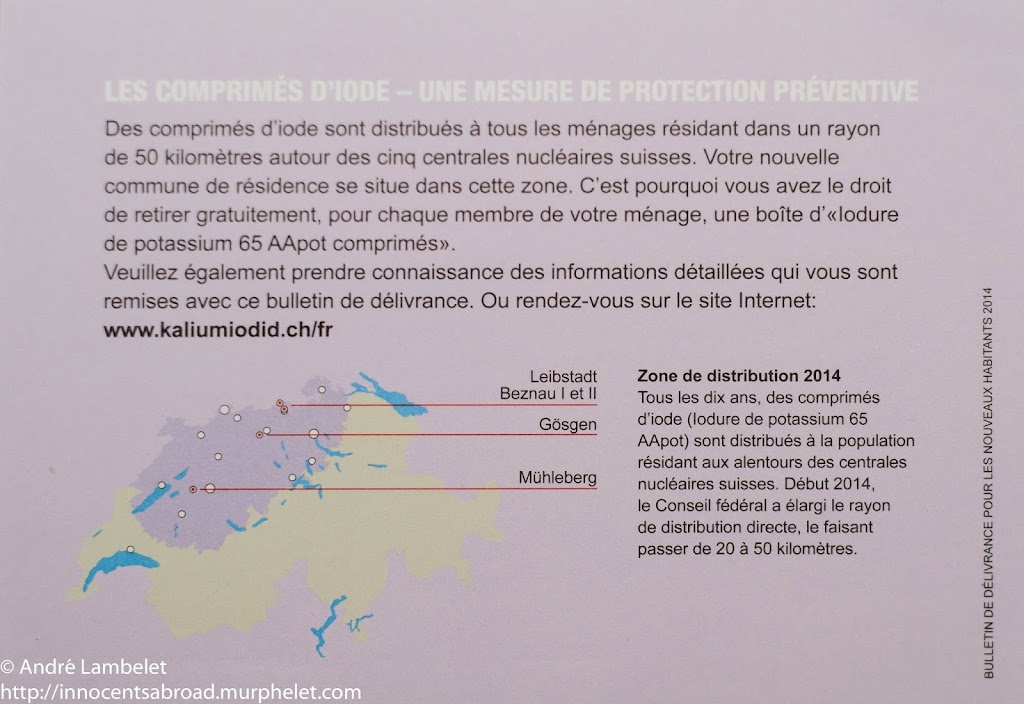
    The person who helped us was cheerful, informative, and helpful. She explained a number of things that weren’t self evident to us — and provided us with a whole slew of coupons that allows us to get reduced fares on public transit, get cheap entry to the swimming pool and the ice rink (in season, of course), and, with a wry smile, presented us with these:

    These are coupons for free iodine — in case the nuclear power plant in Bern goes kaplooey. Cheerful thought.

    This registration thing is a peculiar business. Every Swiss resident is registered, counted, controlled.  There’s no direct or obvious malice here. The point is to gather information for the census, to provide documents to residents — including one called the “Attestation de domicile et de vie” (“Certificate of domicile and of life”) that, the website helpfully notes, is “necessary every time that a person is asked to prove that she is alive.”

    The Swiss take registration for granted. It astonishes them to think that we can move from town to town or province to province without reporting to the local authorities. One of my cousins asked — quite sincerely — how society can function if people aren’t registered. And there is a logic to that question. We tend to rely on blunt (and, with the abolition of the long-form census in Canada, increasingly blunt) tools to tell us where social services are necessary. The Swiss, however, know with astonishing precision how many people live where. And if they don’t seem to ask very detailed questions about demography, they do know very precisely how many children and senior citizens live in an area.

    Yet if there is some utility to this — for school planning, for instance, or for providing assistance to the aged — it’s also a potentially terrifying tool. One of the very questions asked of us was whether we wanted to note our religion in our registration. Good and tidy records may be useful for good causes — but they can also have more nefarious purposes.

  • The first few days

    The first few days

    We’ve arrived in Neuchâtel for a year of work and adventure. Our departure was more hectic than we’d hoped and less frantic than it might have been. With the generous help of family and friends, we managed to get the house in order for our tenants and pile our bags and our bodies into a taxi that was just barely big enough to hold us, but we made it.

    Be prepared!

    The flights — Vancouver to Reykjavik, Reykjavik to Stockholm, and Stockholm to Geneva — were smooth. The kids were well equipped with gadgets — iPods and Kindles and travel pillows and headphones — all of which were speedily put to use. They may have helped distract the kids from the one great disadvantage of our bargain-basement Icelandair flight: the indifferent and very expensive in-flight food. Yup, that’s right: Icelandair charges exorbitant sums for meals on its Atlantic flights. (This may be normal practice in North America, but neither Sophia nor I expected it on a trans-Atlantic journey…)

    Some other quirks: when we disembarked in Reykjavik, we were shunted into a security check. Iceland has visitors to their little country go through a full and agonizingly slow security check, complete, in my case, with a lingering and intimate patdown from a slightly surly security officer. The slowness of the security check meant that we couldn’t grab a sandwich in the terminal, and had to rush to board our next flight. I did — to Sophia’s undisguised horror — grab four Mars bars from the duty-free shop. These helped tide all of us — including Sophia — over until we made it to Stockholm and then, four uneventful hours later, to our flight to Geneva.

    We stayed in a lovely hotel — the Hotel de Genève. I’d highly recommend it. The rooms are lovely, the breakfasts are marvelous (excellent bread, strong, thick, just-brewed black coffee, a little pitcher of hot milk, fresh buttery pastries, and — Nutella. What more could you ask?

    Geneva was in the throes of the Fêtes de Genève, so the streets were lively. We dragged the kids around to some of the places we’d found interesting when we lived there almost twenty years ago. And I tried (not entirely successfully, I fear) to explain the significance of Geneva and its gloomy reformers to the kids. They were not hugely impressed by Calvin’s square-backed chair and the feelings of martyrdom and self-sacrifice that chair must have engendered in the dour Frenchman.

    Geneva: Nathalie, Sophia, and Pierre in the old city

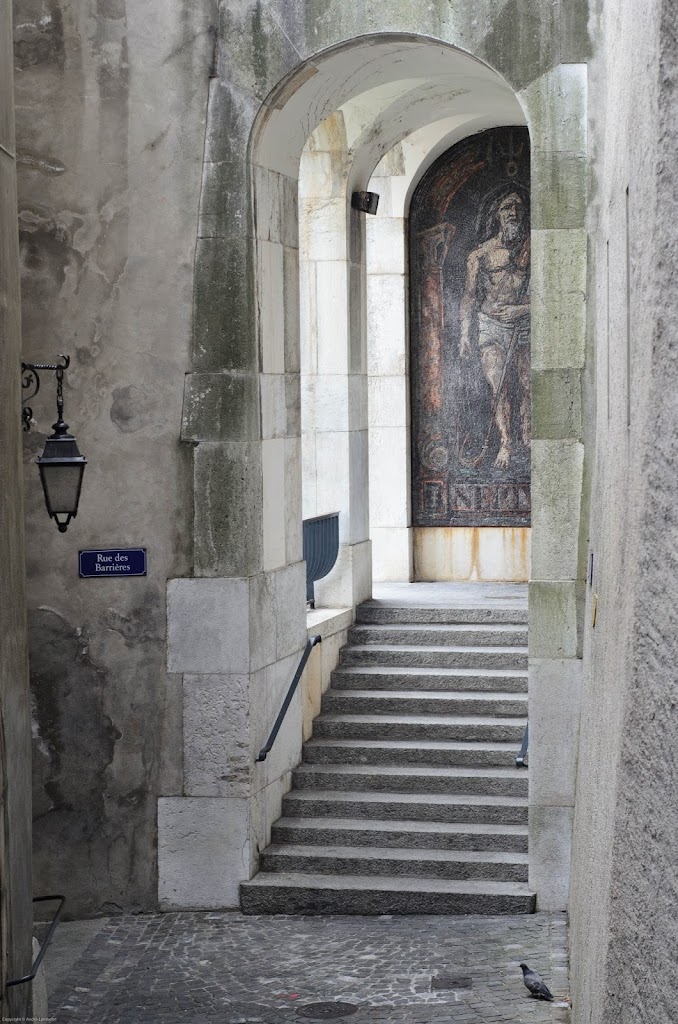
    If you look carefully at the photo above, you may notice the legs of what might have been an Old Testament figure lurking in the mosaic behind the kids. But the kids were delighted to note that this is a mosaic of an entirely different kind of god: Neptune.

    It’s not Abraham, by Jove! It’s Neptune!

    The three of us who don’t suffer from vertigo enjoyed the ferris wheel next to the Pont du Mont Blanc; I sat at the bottom of the dread apparatus and waited a little impatiently for the others to come back to earth.

    Geneva surprised us. Geneva was fun. Just about everyone we had to deal with — the taxi driver who got us from Cointrin to the hotel; the desk clerks at the hotel; the CFF (national trains) agents; and even a pharmacist who sold us bandaids to cover the scrapes that Nathalie suffered when she tumbled down an escalator were delightful.

    There was a serpent lurking in this slightly Edenic Geneva, though. We knew something about the challenges facing us on the final leg of our trip: the challenge of luggage.  We had eight suitcases, each weighing close to the maximum 23 kilograms IcelandAir allows its economy passengers, and more carry-on luggage than a reasonable airline ought to allow. While this posed some challenges — legroom, for instance — it was an inconvenience, not a serious problem. But Swiss trains are a different matter. Boarding a train with two children and thirteen pieces of baggage can’t be done quickly, and even if it could be done quickly, there’s no place to put all that stuff. And getting from the hotel to the train station with that mountain of duffel bags and old suitcases with rickety wheels promised to overwhelm us.

    We worried. And worried some more. What about the disembarkation in Neuchâtel? How were we to get that pile of stuff up the steep hill to our new apartment?

    Salvation unexpectedly lay at the CFF office. It turns out that the railways offer a baggage service — a baggage service that will not only take your bags for you, but will pick them up at any address you choose and deliver them to whatever second address you choose in Switzerland for not very much money at all. And they do it in twenty-four hours. And so we, on August 1, we made our way to the promised land.

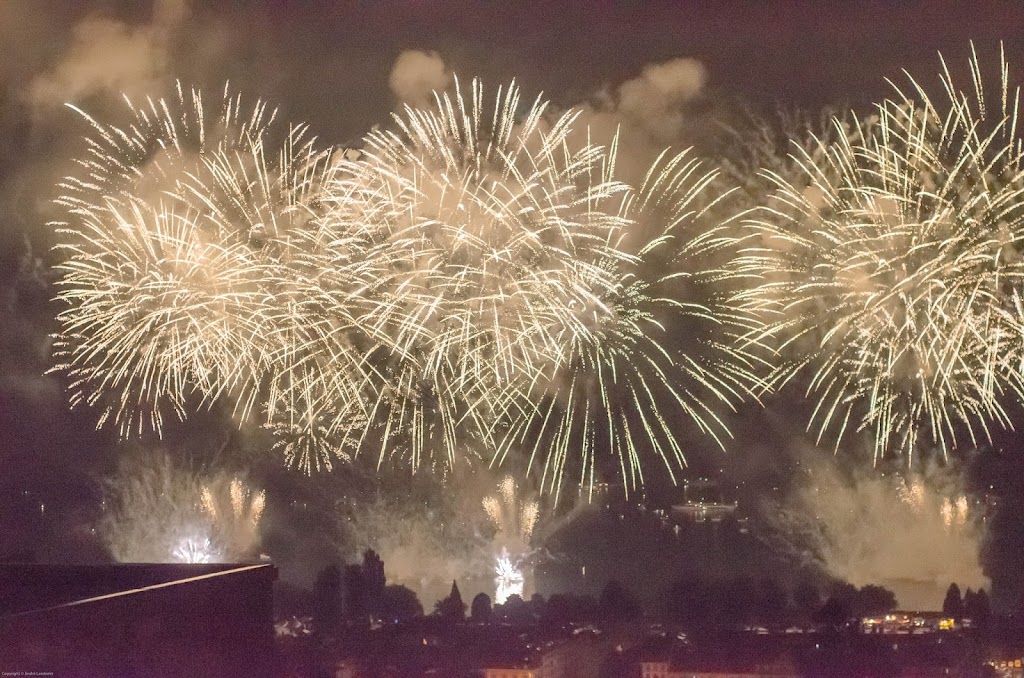
    Here’s what we saw from our living room window that evening:

    The fireworks were spectacular, launched from barges in the lake. And we didn’t feel particularly diminished by the fact that these were not launched in celebration of our arrival… Well. Most of us.

    Sophia did feel a bit smaller the next day.