Category: Uncategorized

  • A Day in the Life

    The Minnesota Driver’s Manual says this about traffic lights:

    A steady yellow light or arrow means “caution.” The signal is about to turn red.

    Do not enter the intersection if you can stop safely before doing so. If you cannot stop safely, proceed through the intersection with caution. If you are waiting in the intersection to make a turn, and the signal turns from yellow to red, complete the turn as soon as it is safely possible. Do not back up.

    That’s pretty clear, I think, and I imagine that most people who read this would have some idea of what to do when confronted with the change from green to yellow.

    But this apparently plain language has me wondering whether the good people of Minnesota speak the same English I do. 

    It’s become something of a sport for us, when we drive across town, to call out the most egregious traffic light transgressors. The other day, I slowed down for a yellow light and came to a stop as the light turned red. I had plenty of time: the light had turned yellow when I was halfway down the block. I could see in the rearview mirror that the driver immediately behind me was puzzled at my behavior. The car that had been behind in the right lane zipped through with commendable insouciance as the light turned red; the car behind him surged forward with an enthusiasm that would have been admirable were it not so damnably dangerous.

    I figure that “stop safely” means that I don’t have to slam on the brakes to bring my car to a halt; judging from what is rapidly becoming a robust data set, Minnesotans take the phrase “cannot stop safely” to cover every case in which they perceive the change from green to yellow. In other words, if you’re a Minnesota driver and you see a yellow light, you have two options: continue to drift along at your current speed until you’re through the intersection (that seems to cover most cases); or, if you find yourself at a great distance from the light when it decides to go from green to yellow, accelerate so that you cruise through the inevitable red light just before perpendicular traffic, now on a green light, makes it to the center of the intersection you’re hurtling through. 

    We’re enjoying our apartment, despite some quirks. Sophia is finding that hauling her bike up and down from the basement is a chore. Either she has to shoulder the bike and lug it up the stairs, or she has to push her way past a couple of yapping little canines that seem to think (though, on reflection, I believe these dogs are too small to think) that the pathway belongs to them. Nevertheless, the city is a good one to bike in, and Sophia is able to commute to work fairly easily. (When we last lived here, Sophia managed to bike to work almost all year ’round; we still have the “lobster gloves” that made it possible to retain some feeling in the hands when it’s well below freezing.)

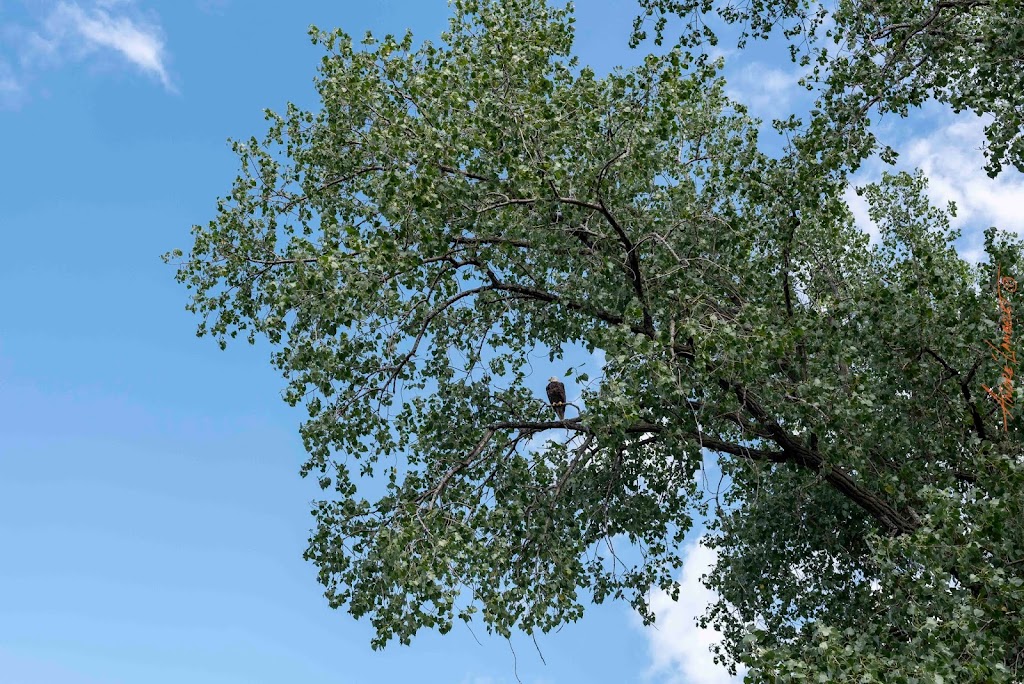
    Being outdoors here is lovely. The lakes are beautiful. The parks are gorgeous. It doesn’t have the wildlife we got used to in Brackendale, though, as you might have noticed in my last post, we have seen a bald eagle here. There are no bears, and garbage cans need not be locked to prevent ursine depredations. But, too make up for that lack of bears, there is a burgeoning population of rabbits. They’re cute little things, but I suspect that the vegetable gardeners of the area loathe the little critters. There are no coyotes here (as far as I know) to keep a check on their population.

    Rabbits are charming, even if they break the hearts and destroy the ambitions of back-yard gardeners. They hop; they twitch their big ears fetchingly; they look up you with their big, brown eyes that proclaim their innocence. And we fall for it: we, even in our assessment of the animal world, are conditioned to make false judgments on the basis of looks.

    The other night, a critter that doesn’t benefit from this privilege paid us a visit. I woke to the sounds of distress–a soft, almost whimpered, plea for help from Nathalie. It was well past midnight, and, in my drowsy state, I had a really hard time figuring out what was going on. “Frog,” she croaked. “FROG.”

    Note: I’m not at my best when I’m awoken in the middle of the night. I’m also not wild about amphibians, reptiles, or insects. The combination of being roused in the dead of night and allegations about frogs was too much for me to deal with, so, with my customary gallantry, I handed the problem off to Sophia.

    It turned out there was a frog. In our bathroom. We’re on the second floor. Sophia, who is pretty good at handling critters of all sorts, tracked the frog down (it had hopped, softly, softly, from the bathroom to the dining room), trapped the poor little amphibian in a bowl, and transported it down two flights of stairs to the great outdoors, where, we hope, it has gone on to a fulfilling life of catching flies and sitting on lily pads.

    It took a little while for the household to settle down. Although I could claim none of the credit for dealing with the amphibian crisis, I did want to find out more about how a frog might have ended up in our bathroom.

    This, apparently, is a thing, and there are whole websites devoted to the phenomenon of frogs, not just in bathrooms, but frogs in toilets. (I know. Gross.) Apparently this can happen because frogs get on roofs. It quickly gets too hot on the roof for the moisture-loving beasties, so they look for cooler places. One of those cooler places is the sewer vent. Frog then tumbles down the sewer vent into the sewer, and then the poor little thing begins a long arduous journey through the sewer pipes and eventually into a toilet. Definitely gross. But perhaps better for us than what can happen in tropical climates, where snakes have been known to do the same thing.

    [By the way — if you read this (and enjoy it), let me know.]

  • Pithy comments

    Pithy comments

    It has been a whirlwind. 

    When I last wrote, we had just arrived in Minnesota; we are now in Minneapolis, settling into our apartment a stone’s throw from Lake Harriet and Bde Maka Ska, the lake formerly known as Calhoun–and before that, Bde Maka Ska, which means “Lake White Earth.”

    John Calhoun was, of course, an important American politician: a Representative, then Senator from South Carolina; Secretary of War; Secretary of State; and Vice President of the United States. But he was also a fanatical defender of slavery. When we last lived here (it seems like it was a thousand years ago–and indeed it began in the last millennium), there was little public controversy over the name, but that has changed. As has Minnesota.

    Signs of that change abound. “Black Lives Matter” signs are everywhere: lawn signs, signs propped up in windows, murals, graffiti. The police precinct station we drove by is encircled by storm fending. Windows on some businesses are still boarded up. And little wonder: over the past year, this city has been roiled by the consequences of decades of heavy-handed police action. I do believe, though, that the people of greater Minneapolis will continue to make progress in the struggle against intolerance and hatred. (I wouldn’t be here if I didn’t believe that.)

    Many Americans will know that Ilhan Omar is a Member of the House of Representatives from Minneapolis; many will also know that Omar is a member of the most rapidly growing populations in the Twin Cities: Somalis and Somali-Americans. When last we lived here, the Somali population was beginning to flourish; now, some estimates place it at 80,000 or so. Many women wear distinctive long, flowing dress and the hijab. 

    And those of you who watched the Olympics may have noted that Suni Lee, the winner of the all-around gymnastics gold medal, is from the Twin Cities; she’s of Hmong descent. Minnesota is not just Vikings and lutefisk anymore.

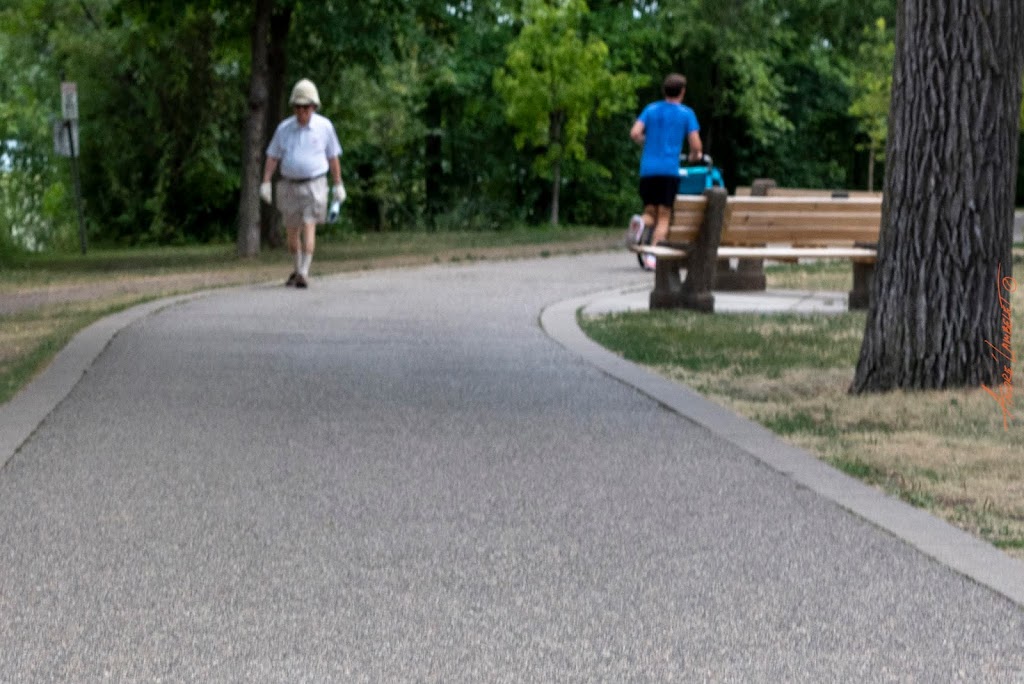
    And then there’s this. We went for a walk along Lake Harriet on Sunday and came across this: a man of a certain age wearing shorts that would not looked out of place on a civil servant in the Raj, an honest-to-god pith helmet and gloves. 

    (I took the picture in part because it seemed a hallucination.)

    The structure of the city has changed. It’s built up. Downtown is home to huge, gleaming buildings. Many of them seem forbidding, a bit soulless, but that may be in the nature of downtowns. The old Metrodome is gone, replaced by a shiny fixed-roof stadium. There’s little threat that this will collapse the way the Metrodome did a few years ago. But the roads are still pretty bumpy. I wonder if any of the long-delayed infrastructure bill will be used to resurface any of the roads around here?

    To be frank, in our first week, it was hard to appreciate much of anything about the city. The heatwave that settled over the Midwest was hard. Minneapolis just is not built for that kind of heat. And, of course, the humidity. One of the delights of wearing glasses is stepping out of an air-conditioned car into the sauna of summer heat, and having the lenses fog up. And in that weather, clothes get damp and stick to you in uncomfortable ways. Breathing is a bit harder, particularly with the thick Canadian smoke that hung in the air. (Minneapolis recorded its worst air quality day ever last week.)

    I’ve no doubt buried the lede here, but last Thursday, Sophia successfully defended her doctoral thesis. In this year of remote everything, the defense took place on Zoom. We had a lovely celebration in the back garden of our friend Ricki’s house. (Ricki not only hosted this soirée for Sophia, she also put us up for a week in her lovely house!) The celebration was an occasion to reconnect with old friends, and to make a few new ones, as well. And Ricki managed to get the people gathered in her backyard, including me and the kids, to join in a rendition of “For she’s a jolly good fellow.” Which, I think, is a major work of black magic.

    It’s been a tumultuous few months for all of us, but particularly for Sophia: getting a new job, selling a house and packing it up, finishing a thesis, crossing a border and getting a visa, finding a place to live, and, now, the biggest challenge of all: coping with the myriad forms of the monstrously complex American health care system.

    American health care is broken. It’s not just that it’s hideously expensive; it is frighteningly difficult to understand. If you’re lucky enough to get employer health care, you have to make difficult choices. How big should your deductible be? If it’s bigger, your premiums are lower; if it’s smaller, your premiums are higher. Making these choices is based on the ability to make reasonable forecasts about the state of your health, but it’s damned difficult to make predictions about your health unless you’re already sick or injured. And the math that goes with those choices isn’t clear. Then you add in other quirks of the system. If you pick a so-called “High Deductible Health Plan” (or HDHP) then you might qualify for a Health Savings Account (HSA). Got that? You may only contribute to your HSA if you have an HDHP. 

    What is an HDHP? Well, silly, it’s a plan where the minimum deductible (the amount you pay for health care items and services before your plan starts to pay) is $1400 for an individual or $2800 for a family, and your maximum out of pocket expenses will be $7000 if you’re an individual or $14,000 if you’re a family and goddamn why is my calculator smoking?

    My American friends will take all of this for granted. We, however, are used to systems where, if you’re ill, you call your doctor and get an appointment and meet the doctor and get treatment and go home and that’s it. Really. That’s it

    Example 1: A few years ago, I stepped on a plank in our back yard. No big deal. Except for the huge rusty nail that went through most of my foot. I went to the walk-in (well, ok, hobble-in) clinic. They took one look and sent me to the ER. I went to the ER. Saw a doctor. Got IV antibiotics. Had to go back every day for a week or ten days. And, apart from filling in a form at the beginning and showing my health card, never had to do anything more.

    Example 2: I’ve been plagued by sinus headaches since I was a kid. My GP got me in touch with a specialist and made the referral. The specialist did his thing, told me he thought I could benefit from surgery. We talked about it for quite some time. What did we talk about? The actual medical benefits and risks. Not insurance. Not payments. Or copayments. Or premiums. I didn’t have to worry that my anesthetist was from out of network. Nope. All I had to do was worry about getting home after surgery — and my friends Darcy and Marjorie took care of that worry for me.

    Just getting signed up for healthcare here is daunting, and I cannot understand how someone who is struggling to make ends meet, to deal with the pressures of work and parenting and transport and all the stuff that makes life difficult could possibly be expected to make good choices on this stuff.

    Why, by the way, do Americans accept the notion that healthcare is an insurance problem rather than a public health problem? It’s incredible. Just incredible.

    The cherry on top? The United States pays more per capita for healthcare than any other OECD country. And its residents still have to deal with this.

    Ok. That’s off my chest. For now. (Wait until I actually have to use this byzantine system. You’ll hear about it, believe me.) 

    We’ve joined the local Y, which has a terrific gym. And it’s not particularly crowded. Signing up was a bit of a chore; the person helping us told us–about fifteen or twenty times–that she’d only had two hours’ sleep in the past two days, kept asking us if she made us feel uncomfortable (by the eighth time she asked, I think, I was beginning to feel distinctly uncomfortable…), and kept forgetting what she was doing. We did get through the process eventually, and now Pierre has a second home.

    Back to our apartment. It’s a lovely place, a bit cluttered with the owner’s stuff. It’s a mile and a half (about 2.4 km) from Nathalie’s school, a fifteen minute walk from Sebastian Joe’s, one of Minneapolis’ fabulous ice cream places, and, as I’ve said, a stone’s throw from Lake Harriet. The path around Lake Harriet is heavily (but not excessively) used. There are concerts in the park near here (classical as well as other).

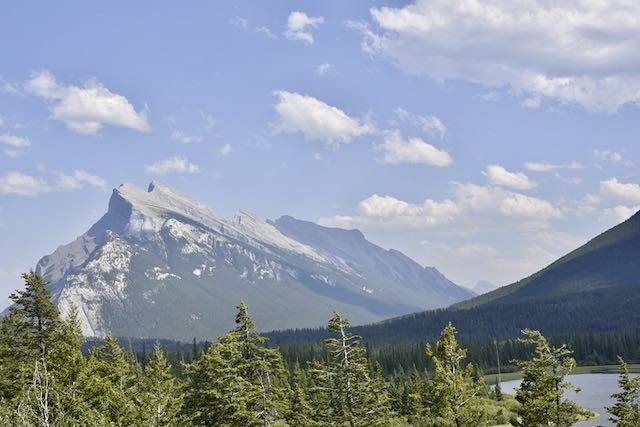
    There is still lots to do to get settled in, but we’re beginning to feel a bit more like we know which side is up. And when we look up, sometimes we see familiar things. Beautiful things. Take a look.

  • Changes

    Changes

     We’re in the final stretch. We left Montana Wednesday morning, drove more or less straight through North Dakota, and arrived at our friend Kate’s cabin at Stalker Lake, in Otter Tail County, Minnesota in the late evening.

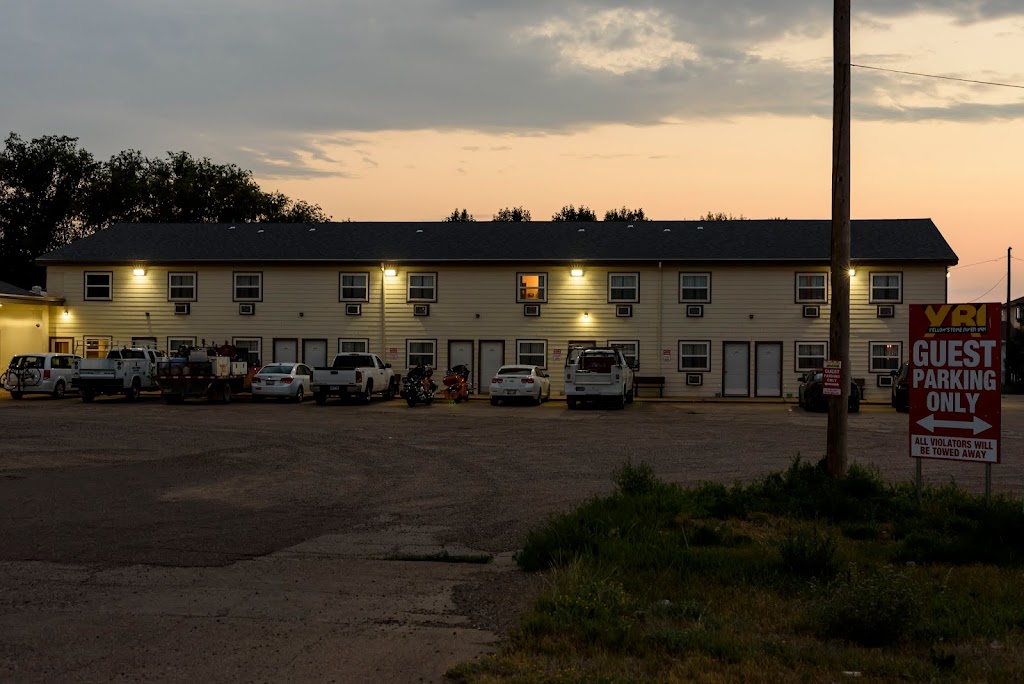
    Image of Yellowstone River Inn

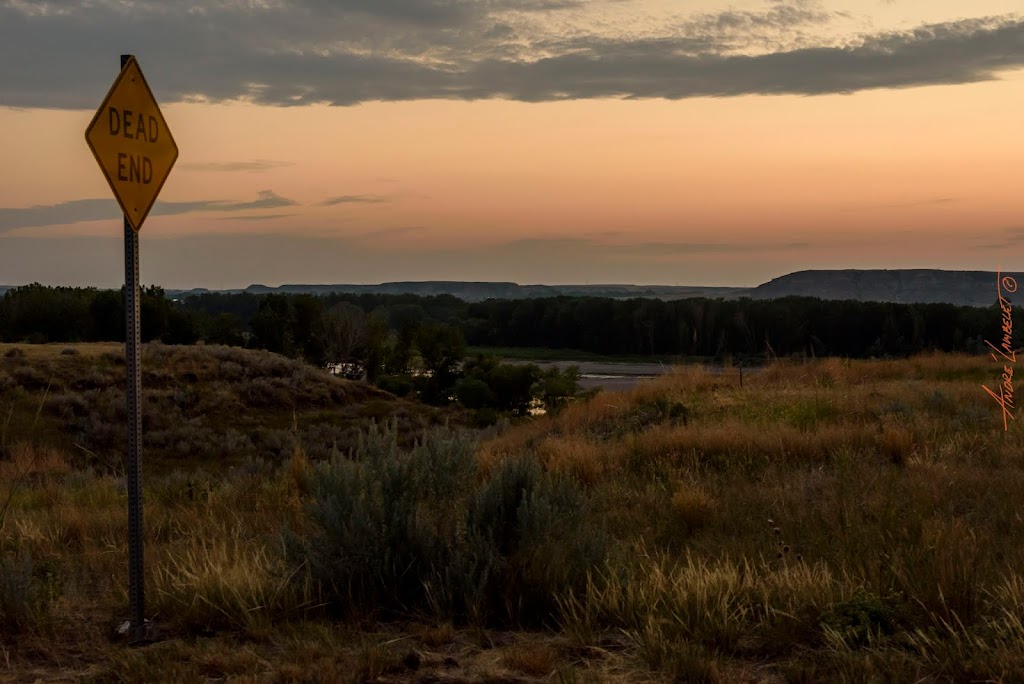
    The motel we stayed in on Tuesday night was the Yellowstone River Inn, in the town of Glendive, Montana. If you’re ever in Glendive and need a place to stay, I’d recommend it. It’s surrounded by standard, soulless chain hotels: the Holiday Inn Suites; a Comfort Inn; a Super 8. The Inn, though, was comfortable; the rooms were spacious, clean, and comfortable; and the staff were friendly. It’s also attached to restaurant, bar, and casino. And, a short walk away, you can look out over the beautiful eastern Montana landscape.

    The food is good, but if you’re looking for small portions of delicately prepared vegetarian food, this won’t fit your bill. We had dinner there, and, because we wanted to hit the road straight away, breakfast the next morning. I’m sorry I didn’t take a picture, because portions were… huge, probably three times bigger than anyone really needs.

    There were a fair number of other people in the restaurant at breakfast, but they didn’t seem to be travelers. Most were older men, with trucker caps, mostly, wearing overalls or dungarees with suspenders. I’m always struck, in places like this, how our clothes help identify us. Subtle differences say a lot. A baseball cap and a trucker cap look a lot alike, but they don’t mean the same thing, do they?

    No one was wearing a mask here. Three of us have all our shots, but one of still needs to get a second. And, given the surge that seems to be happening in the U.S., it seems sensible to wear them. But the only people along the way sporting masks were employees of chain fast food places .(Subway and Starbucks–and yes, we stopped several times at both along the way; I for one will be glad not to set foot in a Subway for a long, long time). Donning a mask in a place like this is a statement, even if it’s not meant as such. And people notice. There’s no hostility, but people do stare, just a bit, just long enough to make it plain that this is strange behavior.

    One of the curiosities of this part of the country is the kind of public sculpture off the highway. I’ve already posted a picture of the metal horses (the “Bleu Horses”) near Three Forks, Montana, but there’s more. There’s a giant cow further east on I-94. 

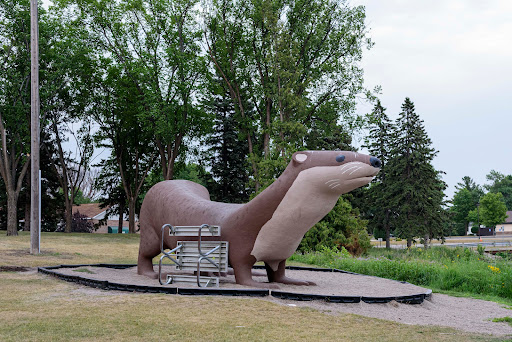
    Kate told us to make a detour through Fergus Falls, Minnesota, so we could see “Otto the Otter.” This is a forty-foot concrete and steel beast, made by high school students in 1972 as a centennial gift to the town of Fergus Falls. (Why choose an otter? Well, Fergus Falls is in Otter Tail County.)

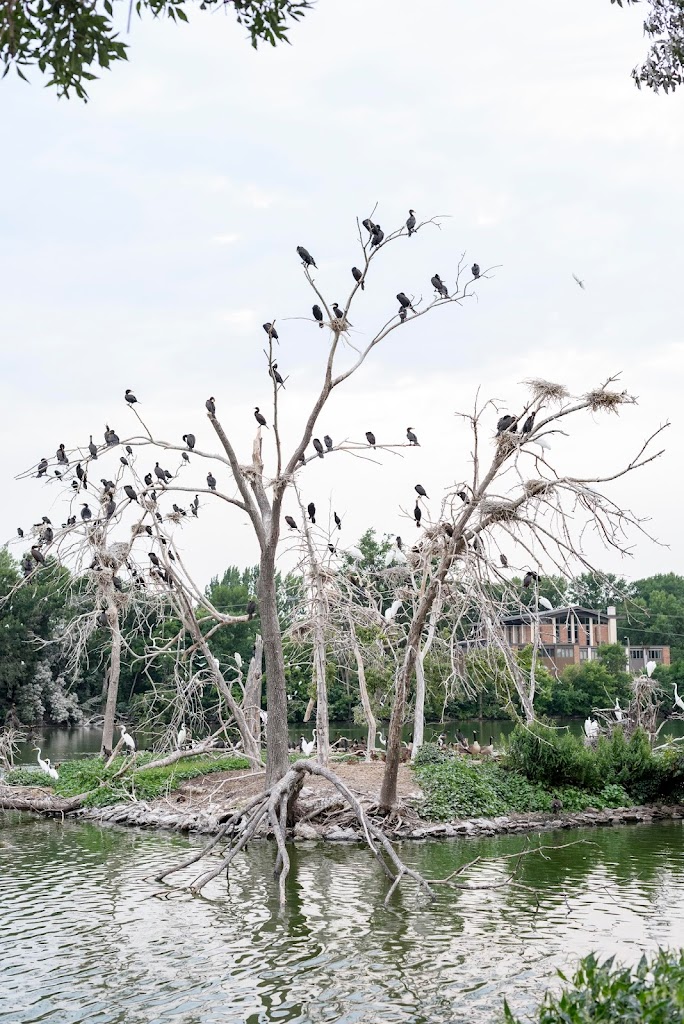
    There’s also an egret rookery in this park, which is pretty cool.

    From there it was a short drive to Kate’s cabin, but we managed to get lost. Waze, it turns out, isn’t perfect. It had us drive in a big loop, and once we were near the end of the loop, seemed to suggest that we do it all over again. (We didn’t. Sophia got in touch with Kate, who set us straight.) We had a cabin to ourselves, which was lovely. And we had a kitchen, so we could cook our own food, which, after a few days of road fare, was really welcome.

    Yesterday we took a day off. Kate and her partner Bob took us to a swimming lake. (Minnesota doesn’t just have ten thousand lakes; there are swimming lakes and fishing lakes and oh-my-god-it’s-just-leeches-and-mosquitoes-lakes and lakes where people go to jetski and… well. You get the picture.) And then Kate and Bob took us to dinner in the metropolis of Battle Lake, Minnesota, population 875. (To be fair, the summer population is a lot bigger; lots of people go to their cabins in the summer but don’t figure in the census.) Stub’s, the restaurant, has a big sign out front proclaiming that it’s the “second best restaurant in Minnesota.” (The sign doesn’t say what the best restaurant is.) And the food is damned good, though definitely not good if you’re vegetarian. (When you order a main dish, you get a choice of potato or green beans.)

    Sophia and I last drove across this country almost twenty years ago, on a journey that would bring us first to Eugene, then to Adelaide, then to Squamish. The landscape hasn’t changed much, and the fascination with huge statues of animals was there, too. (Also the fascination with large anything; I remember driving through Darwin, Minnesota, and stopping to see the world’s largest ball of twine.) There’s a sense of whimsy here, I think. 

    That sense of whimsy tends to come crashing down when you see a picturesque barn, weathered beams sagging with age, emblazoned with a sign that shouts “Trump!” in huge red letters. Or when you see billboards along the side of the road that command, “Choose Life!” Or the billboard back in Montana (Billings, I think) that has a picture of rioters and warns, “If you don’t want Billings to be like Portland, vote Republican.” And there’s the overwhelming whiteness of this part of the country. Every single person in the restaurant in Battle Creek was white: servers, host, clients. Every single one. All the patrons in their caps and their dungarees in Glendive were white. And at truck stops and gas stations, the overwhelming majority is white. And I worry that the word in red on the dilapidated barn represents all of these people, that that is some inexorable force pushing this country into the hands of intolerant and unpleasant people.

    Then I stop. And I reflect. This country has changed tremendously since I last lived in it. Yes, there’s Trump and the anti-vaxxers and horror of white supremacy. But I remember, too, that if the country changed for the worse in 2016, much good has happened here since we headed for Australia back in January 2004. I remember that DOMA, the Defense of Marriage Act, was the law of the land. And remember, too, that Barack Obama was still a state senator then; he wouldn’t win the primary until March of that year. I remember that people thought that no African American would be president in our lifetimes. Bad things happened in our absence, but important strides were taken, too. I remind myself that a couple of days ago I was smiling about a billboard advertising, “Adam & Eve, Your Romance Superstore.” And I have to tell myself that we’ve only seen a handful of Trump signs, and that the changes in America since we left for Australia in 2004 haven’t all been bad.

  • Big Sky Country

    Big Sky Country

    Montana is vast.

    We crossed the border at Sweetgrass yesterday at midday; tonight, we are in Glendive, near the North Dakota border, but still in Montana. We could–and probably should–have made better progress, but we had decided to swing down to Helena rather than cut directly across the state. 

    We did have our reasons. To begin with, we weren’t sure how long it would take to get across the border. Sophia needed to get a TN visa, and we had no idea (but buckets of trepidation) about how long that would take (or if the visa would be granted at all). Sophia was also importing a car; that, too, was a source of anxiety. And just as importantly, it was Pierre’s eighteenth birthday, and we wanted not to spend the whole day in the car.

    This trip, though it traverses some of the most beautiful places in the world, was not undertaken with tourism in mind. Since we’re towing a trailer, and none of the licensed drivers has much experience driving with trailers, we chose to stay in places near the highway. This meant that we stayed in the ugliest part of Lethbridge (at least we hope it was), and in a not-so-charming part of Helena.

    But back to the border. The crossing at Sweetgrass is one of 14 designated “POEs” (points of entry) for people seeking a TN visa. We had a two-minute wait, then pulled up to the booth. We handed over our passports to the officer in the booth, who took a quick look and said, “One of these is not like the other ones.” (The kids and I have US passports; Sophia, of course, was on her Canadian passport.) I was in the driver’s seat, so answered. “Yeah, uh, speaking of which… Sophia is applying for a TN visa.” Which then launched a slightly awkward conversation; I don’t think the officer was sure whether he wanted to speak to me because I was in the driver’s seat or to Sophia because she was the one applying for a visa. But it got sorted quickly. He asked all the usual questions about what we were bringing in. “A bike, our dishes, our clothes,  a piano, and… eh… a bottle of scotch and five bottles of wine.” All of which was true. And we had to add that Sophia was not just applying for a TN visa, but also seeking to import her car.

    [Side note: The instructions for importing a car into the US are very particular. The car must be clean, and the undercarriage must have been washed before attempting to import the car. So part of our Lethbridge adventure was trying to find a car/truck wash were we could rinse the road muck off the car. We were daunted by the truck car wash we found: the bays on one side were for 18-wheelers; on the other, they seemed designed to accommodate a Mini Cooper, and nothing larger. We did manage to find a truck wash in Milk River, a few kilometers north of the border, that worked. Whew.]

    The officer didn’t blink at any of this. But he did ask why Sophia was not applying for a green card rather than the (temporary) TN visa. “Just a trial run?,” he asked. “Uh… yes,” Sophia and I both said, more or less simultaneously. We have gotten to the point where we say the same things at about the same time, though most of the time we mean completely different things even when we use the same words. And then we both hastened to add that the marriage thing was no longer on trial; we had settled that. He seemed to be a little amused, but it was hard to tell. He told us to go park our vehicle and enter through the double glass doors in the back. (I loathe the word “vehicle,” by the way. It’s ugly.)

    We did as we were instructed. The office that we entered was vast, with a long grey formica counter separating applicants from officers. There was only one group ahead of us, and lots of officers at desks or behind the counter, so we didn’t expect to wait long. We were all nervous. Sophia was a bit pallid; Nathalie looked agitated; I was aggressively cheerful. Pierre, who quite sensibly opted to hang out in the car while Sophia dealt with the paperwork, had earlier asked what we would do if Sophia did not get a TN visa. We had to confess that Plan B was yet to be written. Pierre did not seem hugely impressed with our contingency planning.

    In the wake of Trump and his politicization of immigration, I would not have been shocked to find an officious bully at the border.  As it turned out, the whole nerve-wracking process was ridiculously easy. The officer who took charge of us was efficient, clear, courteous, and had a sense of humor. He was thorough: checked all the documents, asked all the proper questions, and made sure that Sophia understood exactly what she was doing. So, half an hour or so after arriving at the Sweetgrass POE, we were on the road again.

    One of Montana’s nicknames is “Big Sky Country.” But the skies in northern Montana were leaden, grey with the same smoke that blanketed Lethbridge when we were there. Despite the grey skies, the landscape was stunning. 

    While the skies were grey, Sophia had recovered her color… and a certain impishness. We had all, in our own ways, been nervous about the crossing.

    It didn’t take us too long to get to Helena. We checked into our motel, consulted with the newest adult member of the family about what we should do for dinner, and settled on a place called Bullman’s Pizza, which was within walking distance–and, as it turns out, makes damned nice wood-fired pizzas.

    This morning, we had breakfast at the motel, loaded up the car, and headed east. There are some odd things in Montana. 

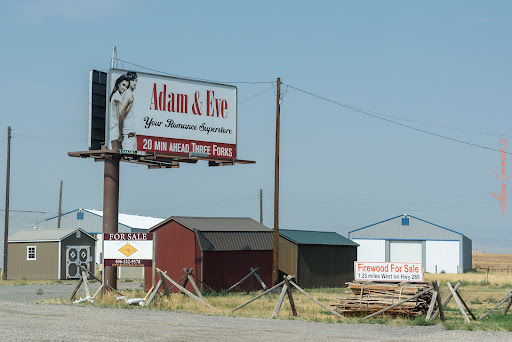
    For instance, it had never occurred to me that one might use Adam & Eve to sell sex toys–but there are enormous billboards along the highway that do just that.

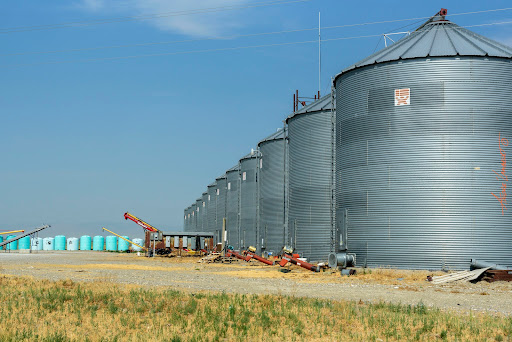
    Then there are the things you might expect in Montana: huge grain storage bins.

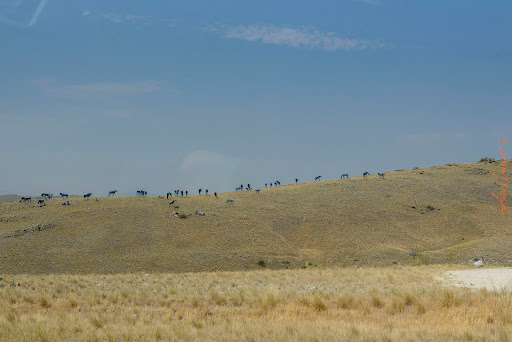
    Horses on a hillside. 

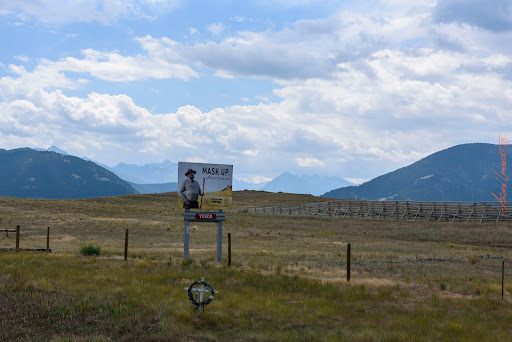
    Oh–wait. Those are fake horses. And, to my genuine delight, injunctions to “mask up”–though this one is made all the more poignant by the marker in front of it.

    Well. It’s late. We are well, though all tired. And I have gone on too long. Tomorrow we cross North Dakota.

  • Bad coffee

    Bad coffee

    There is good coffee, indifferent coffee, and then there is the stuff with which we began the day in Revelstoke: execrable stuff; genuinely undrinkable. But the food was decent, and we didn’t let the coffee spoil our start. (A friend whose judgment I trust, and who has been through Revelstoke many times, tells me that the coffee is a good yardstick by which to measure the town, but we weren’t there long enough to confirm or refute her claim.) 

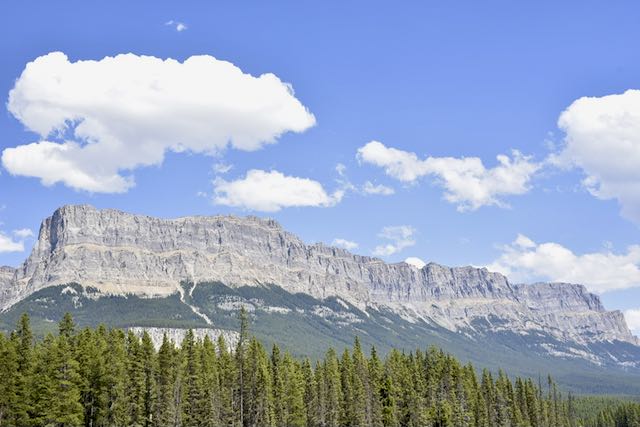
    I started at the wheel this morning, handed the controls over to Sophia in Golden, then slept through much of the most scenic part of the drive. (Timing is everything.) I then followed Nathalie’s lead, and took a few pictures from the moving car… 

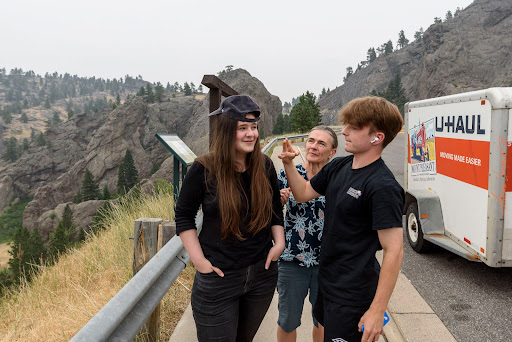
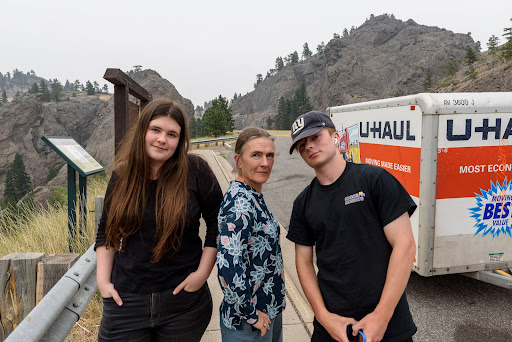
    We did eventually stop, just long enough to stretch our legs, snap a few pics, and switch drivers.

    Pierre, just hours away from his eighteenth birthday, took over for a very long stretch this afternoon, piloting our car and its trailer with aplomb all the way through the maze of the Calgary freeways. (By the way — why, Calgarians, does the right lane keep appearing and disappearing?)

    We finished with a decent Indian takeout in Lethbridge late this evening.

    Tomorrow, we cross the border.