It has been a whirlwind.
When I last wrote, we had just arrived in Minnesota; we are now in Minneapolis, settling into our apartment a stone’s throw from Lake Harriet and Bde Maka Ska, the lake formerly known as Calhoun–and before that, Bde Maka Ska, which means “Lake White Earth.”

John Calhoun was, of course, an important American politician: a Representative, then Senator from South Carolina; Secretary of War; Secretary of State; and Vice President of the United States. But he was also a fanatical defender of slavery. When we last lived here (it seems like it was a thousand years ago–and indeed it began in the last millennium), there was little public controversy over the name, but that has changed. As has Minnesota.
Signs of that change abound. “Black Lives Matter” signs are everywhere: lawn signs, signs propped up in windows, murals, graffiti. The police precinct station we drove by is encircled by storm fending. Windows on some businesses are still boarded up. And little wonder: over the past year, this city has been roiled by the consequences of decades of heavy-handed police action. I do believe, though, that the people of greater Minneapolis will continue to make progress in the struggle against intolerance and hatred. (I wouldn’t be here if I didn’t believe that.)
Many Americans will know that Ilhan Omar is a Member of the House of Representatives from Minneapolis; many will also know that Omar is a member of the most rapidly growing populations in the Twin Cities: Somalis and Somali-Americans. When last we lived here, the Somali population was beginning to flourish; now, some estimates place it at 80,000 or so. Many women wear distinctive long, flowing dress and the hijab.
And those of you who watched the Olympics may have noted that Suni Lee, the winner of the all-around gymnastics gold medal, is from the Twin Cities; she’s of Hmong descent. Minnesota is not just Vikings and lutefisk anymore.
And then there’s this. We went for a walk along Lake Harriet on Sunday and came across this: a man of a certain age wearing shorts that would not looked out of place on a civil servant in the Raj, an honest-to-god pith helmet and gloves.
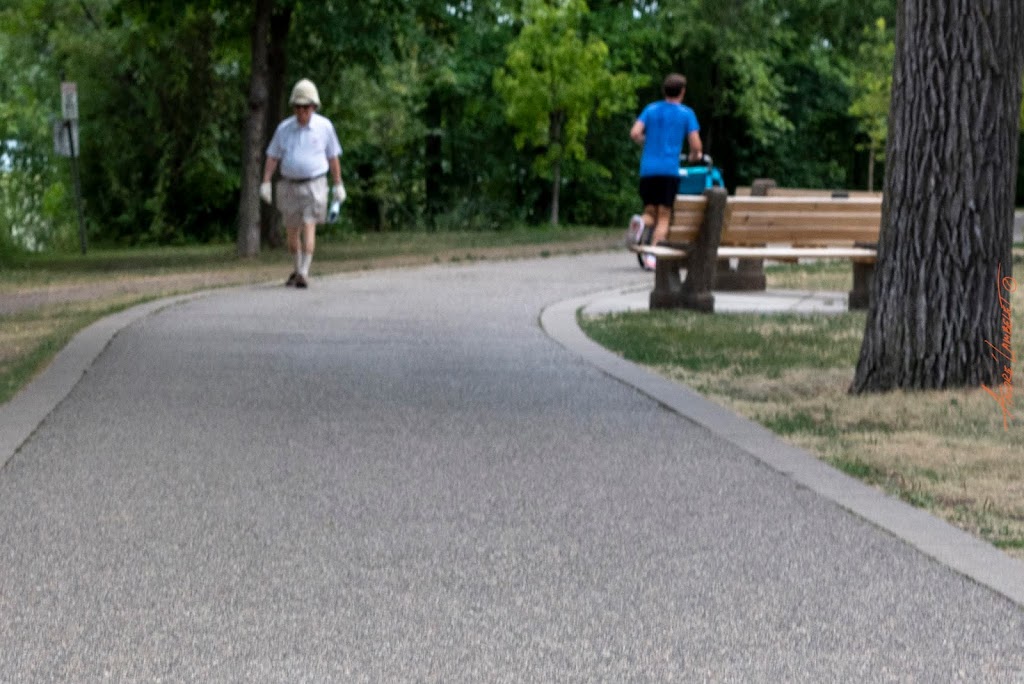
(I took the picture in part because it seemed a hallucination.)
The structure of the city has changed. It’s built up. Downtown is home to huge, gleaming buildings. Many of them seem forbidding, a bit soulless, but that may be in the nature of downtowns. The old Metrodome is gone, replaced by a shiny fixed-roof stadium. There’s little threat that this will collapse the way the Metrodome did a few years ago. But the roads are still pretty bumpy. I wonder if any of the long-delayed infrastructure bill will be used to resurface any of the roads around here?
To be frank, in our first week, it was hard to appreciate much of anything about the city. The heatwave that settled over the Midwest was hard. Minneapolis just is not built for that kind of heat. And, of course, the humidity. One of the delights of wearing glasses is stepping out of an air-conditioned car into the sauna of summer heat, and having the lenses fog up. And in that weather, clothes get damp and stick to you in uncomfortable ways. Breathing is a bit harder, particularly with the thick Canadian smoke that hung in the air. (Minneapolis recorded its worst air quality day ever last week.)
I’ve no doubt buried the lede here, but last Thursday, Sophia successfully defended her doctoral thesis. In this year of remote everything, the defense took place on Zoom. We had a lovely celebration in the back garden of our friend Ricki’s house. (Ricki not only hosted this soirée for Sophia, she also put us up for a week in her lovely house!) The celebration was an occasion to reconnect with old friends, and to make a few new ones, as well. And Ricki managed to get the people gathered in her backyard, including me and the kids, to join in a rendition of “For she’s a jolly good fellow.” Which, I think, is a major work of black magic.
It’s been a tumultuous few months for all of us, but particularly for Sophia: getting a new job, selling a house and packing it up, finishing a thesis, crossing a border and getting a visa, finding a place to live, and, now, the biggest challenge of all: coping with the myriad forms of the monstrously complex American health care system.
American health care is broken. It’s not just that it’s hideously expensive; it is frighteningly difficult to understand. If you’re lucky enough to get employer health care, you have to make difficult choices. How big should your deductible be? If it’s bigger, your premiums are lower; if it’s smaller, your premiums are higher. Making these choices is based on the ability to make reasonable forecasts about the state of your health, but it’s damned difficult to make predictions about your health unless you’re already sick or injured. And the math that goes with those choices isn’t clear. Then you add in other quirks of the system. If you pick a so-called “High Deductible Health Plan” (or HDHP) then you might qualify for a Health Savings Account (HSA). Got that? You may only contribute to your HSA if you have an HDHP.
What is an HDHP? Well, silly, it’s a plan where the minimum deductible (the amount you pay for health care items and services before your plan starts to pay) is $1400 for an individual or $2800 for a family, and your maximum out of pocket expenses will be $7000 if you’re an individual or $14,000 if you’re a family and goddamn why is my calculator smoking?
My American friends will take all of this for granted. We, however, are used to systems where, if you’re ill, you call your doctor and get an appointment and meet the doctor and get treatment and go home and that’s it. Really. That’s it.
Example 1: A few years ago, I stepped on a plank in our back yard. No big deal. Except for the huge rusty nail that went through most of my foot. I went to the walk-in (well, ok, hobble-in) clinic. They took one look and sent me to the ER. I went to the ER. Saw a doctor. Got IV antibiotics. Had to go back every day for a week or ten days. And, apart from filling in a form at the beginning and showing my health card, never had to do anything more.
Example 2: I’ve been plagued by sinus headaches since I was a kid. My GP got me in touch with a specialist and made the referral. The specialist did his thing, told me he thought I could benefit from surgery. We talked about it for quite some time. What did we talk about? The actual medical benefits and risks. Not insurance. Not payments. Or copayments. Or premiums. I didn’t have to worry that my anesthetist was from out of network. Nope. All I had to do was worry about getting home after surgery — and my friends Darcy and Marjorie took care of that worry for me.
Just getting signed up for healthcare here is daunting, and I cannot understand how someone who is struggling to make ends meet, to deal with the pressures of work and parenting and transport and all the stuff that makes life difficult could possibly be expected to make good choices on this stuff.
Why, by the way, do Americans accept the notion that healthcare is an insurance problem rather than a public health problem? It’s incredible. Just incredible.
The cherry on top? The United States pays more per capita for healthcare than any other OECD country. And its residents still have to deal with this.
Ok. That’s off my chest. For now. (Wait until I actually have to use this byzantine system. You’ll hear about it, believe me.)
We’ve joined the local Y, which has a terrific gym. And it’s not particularly crowded. Signing up was a bit of a chore; the person helping us told us–about fifteen or twenty times–that she’d only had two hours’ sleep in the past two days, kept asking us if she made us feel uncomfortable (by the eighth time she asked, I think, I was beginning to feel distinctly uncomfortable…), and kept forgetting what she was doing. We did get through the process eventually, and now Pierre has a second home.
Back to our apartment. It’s a lovely place, a bit cluttered with the owner’s stuff. It’s a mile and a half (about 2.4 km) from Nathalie’s school, a fifteen minute walk from Sebastian Joe’s, one of Minneapolis’ fabulous ice cream places, and, as I’ve said, a stone’s throw from Lake Harriet. The path around Lake Harriet is heavily (but not excessively) used. There are concerts in the park near here (classical as well as other).
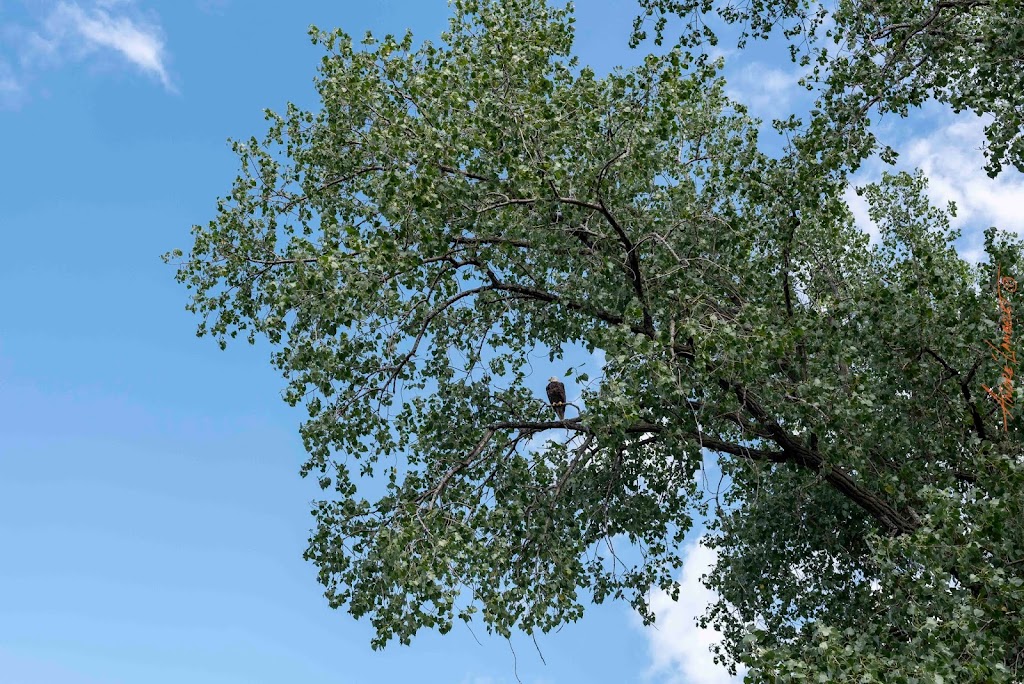
There is still lots to do to get settled in, but we’re beginning to feel a bit more like we know which side is up. And when we look up, sometimes we see familiar things. Beautiful things. Take a look.